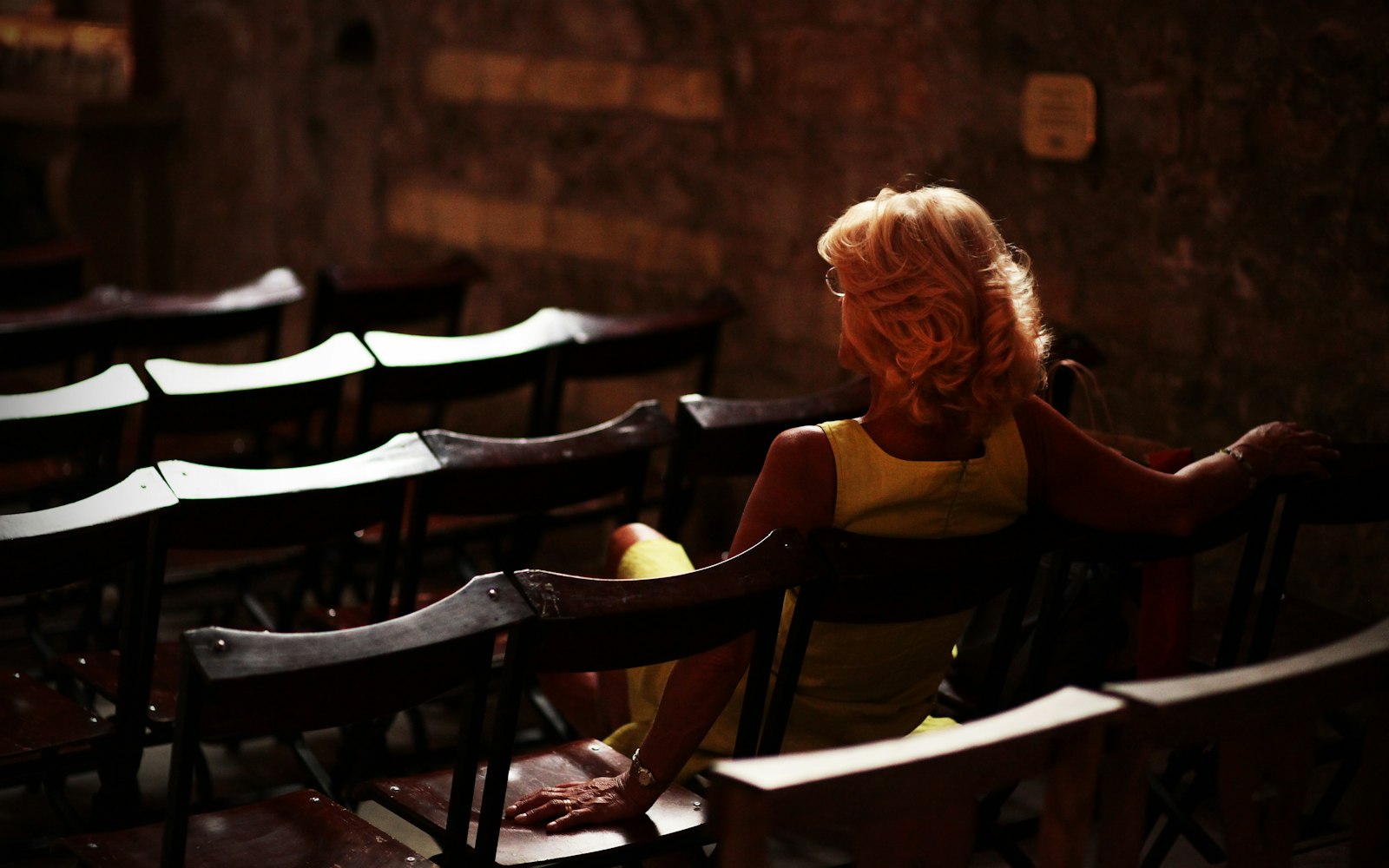
"In the Baltimore of the 1950s, confession was a part of Saturday afternoon," Jacques Kelly wrote in the Baltimore Sun. "You'd see the shoppers take the Charles Street bus home and drop into SS. Philip and James, where a little green light about the size of a Christmas tree bulb would be on."
That light meant a priest was waiting. Priests heard confessions for two hours without a break, took a quick dinner, then returned for two more hours before switching off the signal. It was a rhythm of the city, a feature of the landscape. The confessional was a place in the parish, not an event on the calendar.
Today, that light is mostly off. For the average American Catholic, the path to reconciliation runs through a 90-minute window on a Saturday afternoon, a time slot that competes with soccer games, grocery runs, and Saturday work shifts.
The Church counts baptisms. It counts marriages, funerals, and confirmations. It does not count confessions. In historian James O'Toole's account, a priest calls it the "ghost sacrament"—a sacrament that has no line item in the annual diocesan report, that has become statistically invisible. (O'Toole, For I Have Sinned, Harvard University Press, 2025)
So we counted. We mapped 43,860 confession schedules across 16,609 churches. What we found is a sacrament of mercy constrained by the logic of scarcity—and a handful of parishes proving it doesn't have to be this way.
Key Findings
- 41% of U.S. parishes offer confession just once per week — miss it, wait seven days
- Saturday 3:00 PM is the single most common slot, offered at 2,691 parishes
- 14.2% of parishes list confession as "by appointment only," requiring you to identify yourself for an anonymous sacrament
- Yet parishes that expand hours see immediate demand — one Chicago event drew 2,500 confessions in a single day
Based on 43,860 confession schedules across 16,609 U.S. parishes. Methodology ↓
The Saturday 3:00 PM Monopoly
The data reveals a sacrament compressed into a single, narrow window — spiritual crisis treated with the scheduling rigidity of a bank branch.
36.5%
of all confession slots fall on Saturday
54%
of Saturday slots begin 3:00–4:30pm
41%
of churches offer just one slot per week
40.6%
of slots have no listed end time
Saturday accounts for more confession availability than all five weekdays combined. The single most common start time in America is Saturday at 3:00 PM, offered at 2,691 parishes. Saturday at 4:00 PM is second.
This concentration has consequences. 41% of churches—6,848 parishes—offer exactly one opportunity for confession per week. Miss it, and you wait seven days. Only 34% offer any evening confession (5:00 PM or later). And for 40.6% of all scheduled times, the parish bulletin simply says "Saturday 3:00 PM," with no end time listed. Does the priest stay for 30 minutes or until the line is gone? Compare this to Mass, where start times and durations are published with precision. The ambiguity around confession scheduling reflects a sacrament that many parishes treat as an afterthought rather than a commitment.
If you are a nurse, a cashier, a line cook, or a parent with a weekend full of obligations, the American Church has largely decided that this sacrament is not for your schedule.
How the Window Closed
The Saturday monopoly is recent. Around 1900, a large urban parish operated like a spiritual triage center — multiple priests hearing confessions for hours every Saturday, plus availability on weekday evenings and before daily Mass. The ledger at St. Francis Xavier in New York recorded 173,000 confessions in 1896–97—roughly 475 per day in a single parish, a figure O'Toole unearthed in parish archives.
"From the beginning of the twentieth century into the 1950s, regular confession was a 'defining characteristic' of American Catholic religious life," O'Toole writes. "If Sunday was for Communion, Saturday was for confession."
Then the floor fell out. NORC surveys tracked the collapse in real time: monthly confession among American Catholics dropped from 38% in 1965 to 17% by 1975, settling in the single digits by the mid-1980s. Pew Research's 2025 survey finds that fewer than 1 in 4 American Catholics go to confession even once a year.
Maintenance vs. Mercy: The Priest Math
The decline was not just cultural. It was arithmetic.
In 1970: ~59,000 priests serving 54 million Catholics. Today: ~33,500 priests for nearly 70 million. The ratio of Catholics per priest has more than doubled.
When scarcity forces triage, "maintenance" wins over "mercy." Mass carries a canonical obligation; it must happen. Sick calls are urgent; they cannot be rescheduled. Administration keeps the lights on. Confession — sitting in a quiet box, waiting for penitents who may or may not come — is the easiest thing to cut. It requires dedicated, uninterrupted time and cannot be delegated to a deacon or lay minister.
This is not a story of pastoral negligence. It is a system under scarcity — one in which the infrastructure of mercy has been dismantled, brick by brick, until only the Saturday window remained.
The Anonymity Paradox
The scarcity has produced another, more subtle barrier. In our database, 14.2% of all confession services are listed simply as "by appointment."
It sounds flexible. In practice, it is a wall.
Confession safeguards the penitent's right to anonymity. The screen, the darkened room, the option to kneel unseen—it all exists to separate the sin from the sinner, allowing for total candor. But "by appointment" destroys that anonymity before you ever walk through the door. You must call the rectory during office hours, give your name to a secretary, and negotiate a calendar slot to discuss your most private failures.
The result is a sacrament that requires you to identify yourself in order to remain anonymous.
For someone who has been away for twenty years, haunted by a past they can't shake, that phone call is often an insurmountable hurdle. As Crisis Magazine put it, the lack of scheduled times communicates a message: "Here we do not emphasize the reality of sin or the need for repentance."
The People Who Can't Get In
The stories of those who try to return reveal a longing not for a different theology, but for an open door.
One woman, returning after a decade, walked into a confessional with eight pages of sins she had written out. She was terrified. The priest heard her confession, absolved her, and then told her to go home and burn the eight pages. "That is what Christ has done to your sins," he said. She found a door that was open. (Arkansas Catholic, 2026)
Another man walked into a confessional after 37 years. He was fulfilling a half-promise made to his mother as she was dying. His last confession, decades earlier, had not gone well. The logistics of returning—finding a time, summoning the courage—were as daunting as the act itself. (America Magazine, 2018)
But for every story of return, there are others of rejection. Fr. Andrew Younan wrote on Catholic Answers about "friends who drove a significant distance with their kids to stand in the confession line for an hour or more, only to be turned away at the last minute" when the scheduled time was up.
People are not staying away because they do not want to confess. They are staying away because the door is locked.
The Outliers: Where the Light Stays On
The national picture is bleak, but the data reveals pockets of radical availability. The variation between dioceses is enormous. In the Diocese of Kalamazoo, 93.5% of parishes publish confession schedules. In the Diocese of Fort Worth, it's 89.5%; in the Diocese of Columbus, 88.5%. These are not dioceses with more priests. They are dioceses where access appears to be a priority.
At the parish level, the outliers are even more stark.
At Gesu Church in downtown Miami, confession is available before every Mass, seven days a week. These parishes staff the confessional like an emergency room — not because demand is constant, but because the need is unpredictable and urgent. Canon 986 of the Code of Canon Law mandates that pastors provide for the confessions of the faithful entrusted to them, "on days and at times arranged to suit them." These parishes take the mandate literally.
Demand Follows Supply
The most compelling evidence that availability creates demand comes from dioceses that have tried it. "The Light Is On For You," a program launched by the Archdiocese of Washington and the Diocese of Arlington, opens every parish for confession on Wednesday evenings during Lent. Priests consistently report hearing from people who have been away for decades, drawn back not by a homily, but by a convenient, guaranteed time.
In 2007, an idea from then-Fr. Michael McGovern (now Archbishop of Omaha) — adopted by the Archdiocese of Chicago as "24 Hours of Grace" — saw seven parishes open their doors, and around 2,500 confessions were heard in a single day. The hunger was visible.
Fr. Joshua Caswell, whose Canons Regular staff St. John Cantius, put it bluntly in a 2024 interview: "Demand will consistently meet supply; when confessions are available, people will come." (National Catholic Register)
The demand was always there. It just didn't fit in a 90-minute window on Saturday.
The Recovery Signal
There is a fragile counterpoint in the data. EWTN and RealClear Opinion Research's 2024 poll found that 16% of American Catholics now go to confession monthly, up from 10% in 2022. The share who say they never go dropped from 35% to 18%. (Pew Research's 2025 survey tells a more sobering story — only 23% go at least once a year — but the two surveys measure different things and cannot be directly compared.)
If the 16% monthly figure holds, it represents roughly 11 million American Catholics who want to confess at least once a month. Forty-one percent of parishes offer one slot per week. The math does not work — a recovering patient trying to squeeze through a door that has been welded shut.
A Place, Not an Event
The standard narrative of confession's decline is one of theology and culture — that modern Catholics have lost the sense of sin. Our data suggests a simpler, more structural story. Confession did not just lose its theological emphasis; it lost its infrastructure. A sacrament that was once a place—a reliable, anonymous, ever-present feature of parish life—became an event: infrequent, inconvenient, and uncertain.
The Church looked at the shorter lines and concluded that people had lost their desire for mercy. It may have been the other way around: people saw the locked doors and concluded the Church had lost its desire to give it.
That little green light, the size of a Christmas tree bulb, that once burned in the window of a Baltimore parish was more than a signal of a priest's presence. It was a statement of priority. It was a beacon for the shoppers stepping off the Charles Street bus, for the worker heading home after a long shift, for the soul carrying a burden too heavy to bear for another week.
In the parishes that keep it lit, the lines remain long. Mercy, it turns out, does not need office hours. It needs an open door.
Find Confession Times Near You
Catholic Index tracks confession schedules at over 16,000 parishes across the United States and Canada. Search by city, ZIP code, or parish name.
Search Confession Times →
Methodology & Sources
Data sourced from Catholic Index's database of parish schedules, covering 43,860 confession service records across 16,609 parishes in the United States as of March 2026. Catholic Index tracks over 23,000 Catholic churches and worship sites nationwide (including missions and chapels beyond the ~17,000 canonical parishes). The 16,609 parishes with confession data represent those that publish schedules online. Parishes without web-published schedules are not included and may skew toward smaller, rural churches with fewer published services. This is a picture of scheduled availability, not actual attendance, which no institution systematically tracks.
Confession slot times, day-of-week distributions, and "by appointment" records were calculated from structured service data. The "40.6% of slots have no listed end time" figure is based on records where only a start time was provided. "54% of Saturday slots begin between 3:00pm and 4:30pm" refers to the start time of confession windows, not their full duration. Diocesan coverage rates represent the percentage of parishes within each diocese for which we have at least one scheduled confession time.
Historical confession rates from NORC General Social Surveys. Current participation data from Pew Research Center (2025) and CARA (Center for Applied Research in the Apostolate) at Georgetown University. Priest population figures from CARA. Canon 986 cited from the 1983 Code of Canon Law (Vatican.va). Historical parish confession counts from James O'Toole's For I Have Sinned (Harvard University Press, 2025). Fr. Joshua Caswell quote from the National Catholic Register (March 27, 2024). "The Light Is On For You" program data from the Diocese of Arlington and the Archdiocese of Washington. "24 Hours of Grace" figures from reporting on the 2007 Chicago event. Returnee accounts from Arkansas Catholic (February 13, 2026) and America Magazine (December 17, 2018). Fr. Andrew Younan anecdote from Catholic Answers.
Know of a parish with extensive confession hours we should feature? Contact us.
- O'Toole, James. For I Have Sinned: The Rise and Fall of Catholic Confession in America (Harvard University Press, 2025).
- Kelly, Jacques. "Remembering When Confession Was Routine Saturday Occasion." Baltimore Sun, March 14, 2009.
- National Catholic Register. "Confession: Offer It, and People Will Come." March 27, 2024.
- America Magazine. "A man walks into a confessional after 37 years." December 17, 2018.
- Crisis Magazine. "On Parishes With Short Confession Times."
- Pew Research Center: "Catholic Practices and Devotions" (June 2025).
- CARA: Center for Applied Research in the Apostolate, Georgetown University.
- Florida Catholic: "South Florida's 'grandmother church'" (Gesu Church, Miami).
- Arkansas Catholic (February 13, 2026).
- Canon 986, Code of Canon Law (1983), Vatican.va.
- EWTN/RealClear Opinion Research: Catholic poll (2022, 2024; n=1,000, margin of error ±3 points).