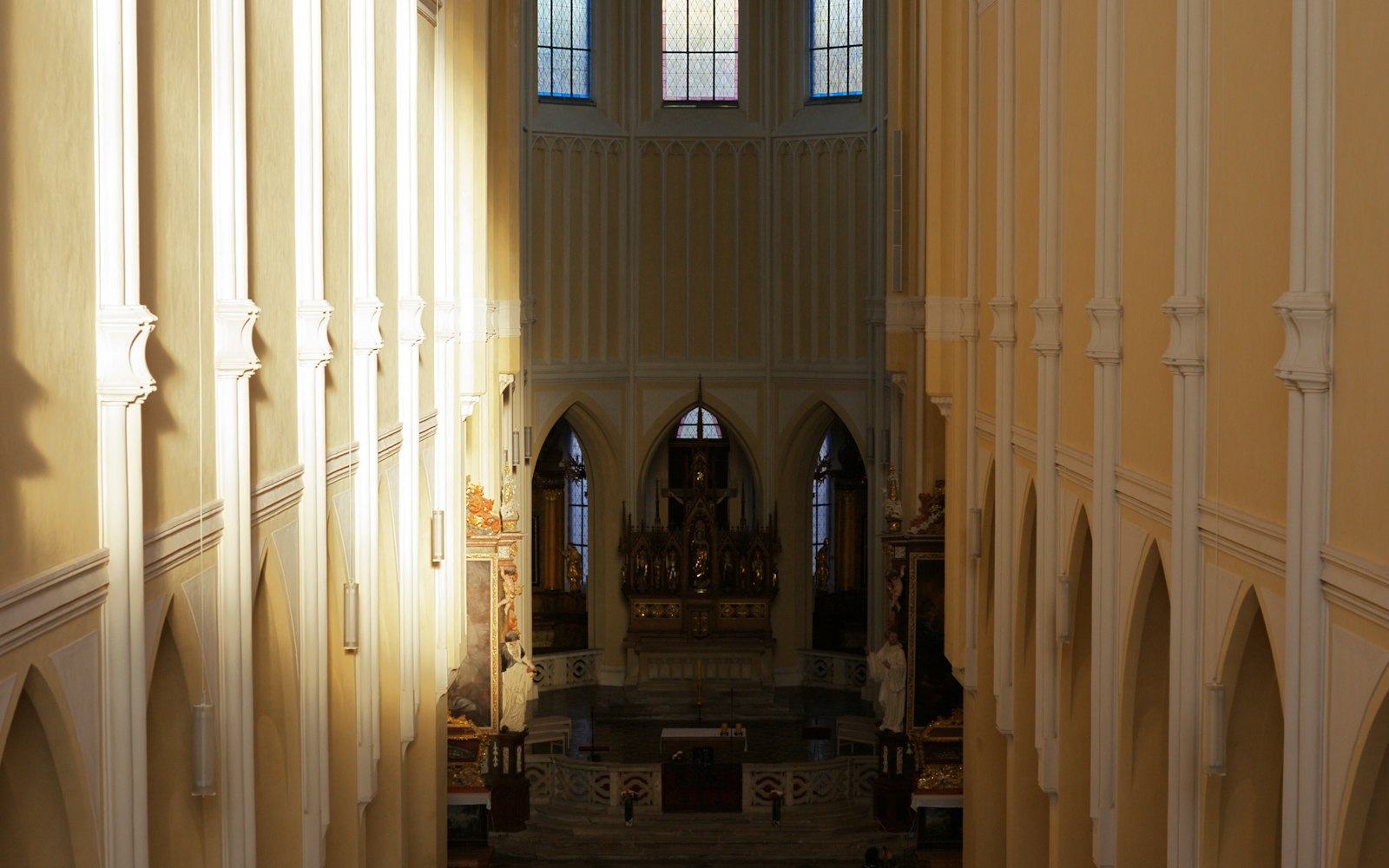
The light that morning was the kind you cannot plan for. Late winter in Berkeley, low-angle sun pouring through the east-facing windows of St. Mary Magdalen Church, landing on the pews and on a massive wooden crucifix that hung above the altar. Jason Blakely, a political philosopher and self-described ardent atheist, had been dragged there by his partner. It was Lent. It was the earliest Sunday Mass. He had no interest in being there.
But in that light, something shifted. Christ appeared both heavy in the hewn wood and somehow levitating in frozen pain and serenity over his cross. Blakely could not look away. He could not explain what he was seeing, and he could not dismiss it. The Mass continued around him — the readings, the prayers, the congregation rising and kneeling — and for the first time in his life, the ritual did not feel like performance. It felt like gravity.
Jason Blakely converted to Catholicism. He is now a professor at Pepperdine University. Writing about the experience in America Magazine, he described his conversion not as an argument won but as a seeing — a moment when the architecture, the liturgy, and the light conspired to make the invisible visible.
Every week, millions of people walk into churches across the United States and encounter a version of what Blakely encountered: a 2,000-year-old ritual that has survived empire, reformation, and modernity. Some come out of obligation. Some come out of habit. Some come, like Blakely, dragged there against their will. But they all walk into the same Mass — the same structure, the same prayers, the same bread and wine offered on the same altar. It is the most widely attended recurring event in the country, and one of the least understood from the outside.
So we mapped it. We catalogued 163,839 Mass services across 18,612 churches in the United States — every Sunday, every Saturday vigil, every Tuesday morning and Wednesday evening. What emerged is a portrait of a country at prayer: its rhythms, its peaks, its silences, and the languages in which it speaks to God.
Key Findings
- 163,839 Mass services are offered weekly at 18,612 churches in the United States — an average of nearly 9 Masses per parish
- Sunday morning has two peaks, not one: 8-9 AM (18.8%) and 10-11 AM (18.9%), splitting the country into early risers and late starters
- Monday has dramatically fewer Masses (~11,000 vs. ~15,000 on other weekdays) — the clergy's unofficial day off
- 1 in 4 parishes with a language tag offers Mass in Spanish, and 622 serve Vietnamese-speaking Catholics — a church shaped by immigration
Based on 163,839 Mass services across 18,612 U.S. churches. Methodology ↓
What Actually Happens at Mass
If you have never been to a Catholic Mass — or if you went once for a wedding and spent most of it wondering when to stand — here is the short version.
Mass has four parts. They are always the same, everywhere in the world, and they unfold in the same order whether you are in a cathedral in Rome or a gymnasium in rural Kansas.
The Introductory Rites are the threshold. The priest processes in, the congregation stands, and there is a moment of collective confession — not the private, behind-the-screen kind, but a communal acknowledgment of imperfection. "I confess to almighty God, and to you, my brothers and sisters, that I have greatly sinned." The room says it together. It takes about five minutes, and it sets the tone: you are here not because you are worthy but because you are not.
The Liturgy of the Word is scripture read aloud. On Sundays, there are typically three readings — one from the Old Testament, one from the letters of the apostles, and one from the Gospels — plus a psalm sung or recited between them. Then comes the homily, the priest's reflection on what was just read. This is the variable. Our analysis of 209,000 livestreamed Masses found that the Sunday homily runs a median of 21 minutes and accounts for roughly a third of the entire service. Some priests preach for eight minutes. Some preach for thirty. The readings are fixed; the homily is where a parish's personality lives.
The Liturgy of the Eucharist is the center. This is what makes a Mass a Mass, and what distinguishes it from a Protestant worship service. Catholics believe that the bread and wine, through the priest's prayer, become the body and blood of Christ — not symbolically, but substantially. The theological term is transubstantiation, and it is not a metaphor. It is the reason a billion people line up every Sunday. The Eucharistic prayer, the consecration, Communion — this sequence takes roughly 20 minutes, and it has not changed in its essentials since the earliest centuries of Christianity. The Second Vatican Council called the Eucharist "the source and summit of the Church's life."
The Concluding Rites are brief. A blessing, a dismissal — "Go forth, the Mass is ended" — and the congregation files out. The whole thing, start to finish, runs about 71 minutes on a Sunday in the United States, 43 on a weekday.
That is it. No altar call, no passing of the collection plate mid-sermon, no megachurch production values. Just readings, a homily, bread, wine, and a room full of people who believe — or are trying to believe — that something transcendent is happening on that altar. As Pope John Paul II put it: "Holy Mass is the absolute center of my life and of every day of my life."
When America Goes to Mass
Of those 163,839 weekly services in the United States, 40,916 are Sunday Masses, spread across 16,813 churches. Sunday is the anchor — the one day the Church asks every Catholic to attend. About 71.1 million Americans identify as Catholic, and surveys suggest somewhere between 24% and 29% show up on any given Sunday (Pew 2025 / Gallup 2025). That is roughly 17 to 21 million people, every week, in the same pews.
The question is: when?
40,916
Sunday Masses at 16,813 churches in the U.S.
18.9%
of Sunday Masses start between 10-11 AM
18.8%
of Sunday Masses start between 8-9 AM
2.4
average Sunday Masses per parish
The data reveals something unexpected: Sunday Mass in the United States has not one peak but two. The 10:00-11:00 AM window claims 18.9% of all Sunday services. The 8:00-9:00 AM window is almost identical at 18.8%. Between them, these two hours account for nearly four in ten of all Sunday Masses in the country.
This is not a bell curve with a single summit. It is a camel's back — two humps, two Americas. The 8:00 AM crowd: daily communicants, older parishioners, parents trying to get it done before the day starts. The 10:30 AM crowd: families with small children, the late risers, the ones who set an alarm and hit snooze. Between them, a brief valley around 9:30 where the early birds are heading home and the late starters are still in the parking lot.
By noon, Sunday Mass is winding down. By 1:00 PM, the church is largely empty — though a scattering of afternoon and evening Masses serve those whose work schedules do not bend to liturgical tradition.
The Saturday Option
The Saturday vigil Mass is, historically speaking, new. Before Vatican II in the 1960s, the Church restricted Mass to morning hours, and the obligation was firmly tied to Sunday. The vigil — a Mass on Saturday evening that "counts" for Sunday — emerged from the post-conciliar reforms and was enabled by a practical change: the Eucharistic fast — which had required abstaining from all food and drink from midnight — was gradually relaxed, first to three hours in the 1950s, then to just one hour before Communion in 1964. Evening Masses became logistically possible for the first time.
Today, the Saturday vigil is woven into the fabric of American Catholic life.
19,711
Saturday vigil Masses in the U.S.
13,750
churches offering a Saturday vigil
65%
of vigils begin between 4-6 PM
74%
of U.S. parishes offer at least one vigil
Nearly three-quarters of all parishes in the United States now offer at least one Saturday vigil. The timing is tight: 65% of vigil Masses fall between 4:00 and 6:00 PM, with 4:00 PM and 5:00 PM as the dominant start times. This is the sweet spot — late enough to feel like evening, early enough that the priest and congregation can still get home for dinner.
The Saturday vigil has become the pressure valve of American Catholicism. It is the Mass for the nurse who works Sunday mornings, the family heading to the lake house at dawn, the couple who wants their Sunday free. It is less crowded than the 10:30, more relaxed than the 8:00. Many regular churchgoers will tell you it is their preferred time — not because they cannot make Sunday, but because they choose Saturday.
The Weekday Regulars
The biggest number in our dataset is not a Sunday figure. It is a weekday one: 70,321 Masses per week happen Monday through Friday in the United States — more than Sunday and Saturday vigil combined.
This is the quiet church, the small church. Weekday Mass draws a fraction of Sunday's crowd — often just a few dozen people in a building that seats hundreds. There is no music, no procession, no homily longer than a few minutes. It is stripped down, intimate, and fast. The whole thing takes about 43 minutes.
70,321
weekday Masses per week in the U.S.
8:00 AM
dominates — 24.4% of all weekday Masses
~11K
Masses on Mondays (fewest of any weekday)
~15K
Masses on Tues-Fri (each day, roughly)
The weekday pattern is strikingly concentrated. 8:00 AM alone accounts for 24.4% of all weekday Masses in the United States — nearly one in four. Add in 7:00 AM and 9:00 AM, and you have captured the vast majority of the weekday schedule. This is a pre-work Mass, a retiree's Mass, a daily rhythm that has not changed in generations. The people who go to daily Mass are, by and large, the people who have gone every day for years.
But the most curious finding in the weekday data is the Monday gap. On Tuesday through Friday, U.S. parishes offer roughly 15,000 Masses per day. On Monday, that number drops to approximately 11,000 — a 23% decline. Monday is, by long tradition, the priest's day off. Canon law does not require it; custom does. The parish office is closed, the rectory is quiet, and the 8:00 AM Mass that happened every other morning simply does not happen. It is the one day the institutional Church exhales.
A Church in Every Language
The Catholic Church in the United States has always been an immigrant church. The Irish built it. The Italians, Poles, and Germans expanded it. Today, the data shows a church being reshaped by a new generation of immigrants — and it is visible in the Mass schedule.
4,646
churches offering Spanish Mass in the U.S.
712
churches with Polish Mass
622
churches with Vietnamese Mass
578
churches with Latin Mass
Among parishes that carry a language tag, 1 in 4 offers Mass in Spanish — 4,646 churches across the country. In Texas, California, and Florida, Spanish-language Masses are not a special accommodation; they are a primary service. Many parishes offer both an English and a Spanish Sunday Mass, with the Spanish Mass often drawing the larger crowd.
The Vietnamese figure — 622 churches — is striking for a community that makes up less than 1% of the U.S. Catholic population. It reflects the deep Catholicism of the Vietnamese diaspora, a community forged in persecution and resettlement that has built its own parishes, its own devotional life, and its own liturgical culture within the American Church. Polish Masses, at 712 churches, trace the old immigrant geography — Chicago, Detroit, Buffalo, the industrial Midwest — but also new clusters in places like New Jersey and Connecticut.
And then there is Latin. 578 churches in the United States offer Mass in the pre-Vatican II form — the Tridentine rite, now called the Extraordinary Form. This is a small number in the context of 18,612 parishes, but it represents a community that is vocal, young, and growing. Whether you view this as a revival or a reaction, it is a measurable presence in the data.
The Mass is the same in every language. The readings change, the homily changes, the hymns change — but the Eucharistic prayer, the consecration, the breaking of the bread: these are universal. A Vietnamese grandmother in Houston and a Polish steelworker's grandson in Chicago are doing the same thing, at the same moment, in different words. That is the theory, at least. And the data suggests it is, in fact, how the American Church operates — not as a single congregation but as a constellation of congregations, sharing one liturgy across dozens of languages.
Can Anyone Attend a Catholic Mass?
Yes. Catholic Mass is open to anyone — baptized or not, Christian or not, believer or not. There is no dress code enforced at the door, no membership check, no ticket. The one restriction: non-Catholics are asked not to receive Communion. Everything else — sitting, standing, kneeling, listening, observing — is open to all.
How Long Will It Take?
If you are considering attending Mass for the first time — or returning after a long absence — the practical question is fair: how long will this take?
We answered this in detail in our companion piece, "How Long Is Mass, Really?", which analyzed 209,000 livestreamed Masses from 3,253 parishes in the United States. The short answer: Sunday Mass runs a median of 71 minutes. Weekday Mass, 43 minutes. The homily accounts for most of the difference.
If you are going for the first time, a weekday Mass is the gentler introduction — shorter, quieter, and with a smaller crowd where you are less likely to feel self-conscious about not knowing when to stand or kneel. Nobody will ask you to do anything. You can sit in the back and watch. If anyone notices you are new, they will likely be glad you came.
The Gravity of Ritual
There are 163,839 reasons every week to walk into a Catholic church in the United States, and the reasons people actually walk in are as varied as the country itself. Obligation. Habit. Loneliness. Grief. Gratitude. Curiosity. A partner who dragged them there against their will on a Sunday morning in Berkeley.
The data we have mapped — the Sunday peaks, the Saturday vigils, the 8:00 AM weekday rhythm, the languages spoken — is a portrait of infrastructure. It is the scaffolding that holds up a practice. But infrastructure is not the practice itself.
What Jason Blakely encountered that morning at St. Mary Magdalen was not a data point. It was not a service time or a language tag or a median duration. It was something that the numbers cannot capture but that the numbers make possible: a room, a time, a crucifix in winter light, and the strange gravity of a ritual old enough to predate the nation, the language, and the building in which it is performed.
Every one of those 163,839 weekly services is, in principle, an open door. The same prayers will be said. The same bread will be broken. Whether what happens after that is a matter of theology or of light through glass — that is between you and the crucifix.
Find Mass Times Near You
Catholic Index tracks Mass schedules at over 18,000 churches across the United States, Canada, the UK, Ireland, Australia, and more. Search by city, ZIP code, or parish name.
Methodology & Sources
Data sourced from Catholic Index's database of parish schedules, covering 163,839 Mass service records across 18,612 churches in the United States as of March 2026. Services include all regularly scheduled Masses (Sunday, Saturday vigil, and weekday). Holy day, funeral, and special-occasion Masses are not included. The 18,612 churches include canonical parishes, missions, and chapels that publish schedules online. Parishes without web-published schedules are not included and may skew toward smaller, rural communities.
Sunday time-of-day distributions are based on the published start time of each service. The two-peak pattern (8-9 AM and 10-11 AM) reflects the number of services, not attendance — a 10:30 AM Mass may draw more people than an 8:00 AM Mass at the same parish. Saturday vigil percentages are calculated from the 19,711 vigil Mass records. The Monday weekday gap is calculated by comparing total Monday services (~11,000) to the Tuesday-Friday average (~15,000 per day). Language data reflects parishes that carry a language tag in their published schedule; parishes offering occasional bilingual Masses without a formal tag may not be captured.
Duration data (71-minute Sunday median, 43-minute weekday median) comes from a separate analysis of 209,000 livestreamed Masses at 3,253 parishes, detailed in "How Long Is Mass, Really?". Weekly attendance estimates (24-29% of U.S. Catholics) draw from Pew Research Center (2025) and Gallup (2025). The figure of 71.1 million U.S. Catholics is from CARA at Georgetown University. Historical context on pre-1953 morning Mass restrictions, the Eucharistic fast reduction (1964), and the introduction of the Saturday vigil draws from liturgical history and Vatican II documents. The Eucharist as "source and summit" is from the Second Vatican Council, Lumen Gentium (1964), no. 11. Pope John Paul II's quote on the centrality of Mass is widely attributed in his biographies and papal writings.
Jason Blakely's conversion account is drawn from his essay "An atheist's return to the Catholic Church," published in America Magazine, December 9, 2024.
Know of a parish doing something remarkable with its Mass schedule? Contact us.
- Blakely, Jason. "An atheist's return to the Catholic Church." America Magazine, December 9, 2024.
- Pew Research Center: "Religious Landscape Study" and "Catholic Practices and Devotions" (2025).
- Gallup: Weekly church attendance tracking (2025).
- CARA: Center for Applied Research in the Apostolate, Georgetown University.
- Second Vatican Council. Lumen Gentium (1964), no. 11.
- Pope John Paul II, on the centrality of the Eucharist.