Get notified when we publish new data-driven Catholic content.
The Stars Come Out in Kodiak
On a December evening in Kodiak, Alaska, when the sun sets before 4pm and temperatures hover near freezing, something unexpected happens. Filipino star lanterns - parols - begin to glow outside homes across the island. Inside St. Mary's Catholic Church, a congregation that is 75% Filipino gathers for Mass.
This is Simbang Gabi in Alaska. And Kodiak might be the most surprising place in America to find it.
Filipinos make up roughly 30% of Kodiak's population - one of the highest concentrations of Filipino Americans in any U.S. city. They came for the canneries, for the Coast Guard, for work. They stayed, and they brought their faith with them.
But here's the thing about Simbang Gabi in Alaska: dawn comes too late. The traditional 4am Mass doesn't work when sunrise isn't until 10am. So the community adapted. They celebrate in the evenings instead, rotating between parishes, gathering for potluck dinners of pancit and lumpia after Mass.
The tradition bends. The faith holds.
What Is Simbang Gabi?
Simbang Gabi (literally "Night Mass" in Tagalog) is a nine-day novena of Masses leading up to Christmas, celebrated December 16-24. In the Philippines, these Masses traditionally begin before dawn - as early as 3am or 4am - earning the Spanish name Misa de Gallo (Rooster's Mass).
The tradition dates back over 400 years to Spanish colonial Philippines. Farmers needed to attend Mass before heading to the fields at first light. Fishermen came to shore after all-night fishing. The pre-dawn timing was practical, but it became sacred.
There's a popular belief: complete all nine Masses, and your special intention will be granted.
For Filipino Catholics, Simbang Gabi isn't just a religious observance. It's the heartbeat of Filipino Christmas. The smell of bibingka (rice cake) and puto bumbong (purple rice delicacy) sold outside churches. The sound of carols in Tagalog. The sight of parols illuminating the darkness. It's home.
And increasingly, it's home in America.
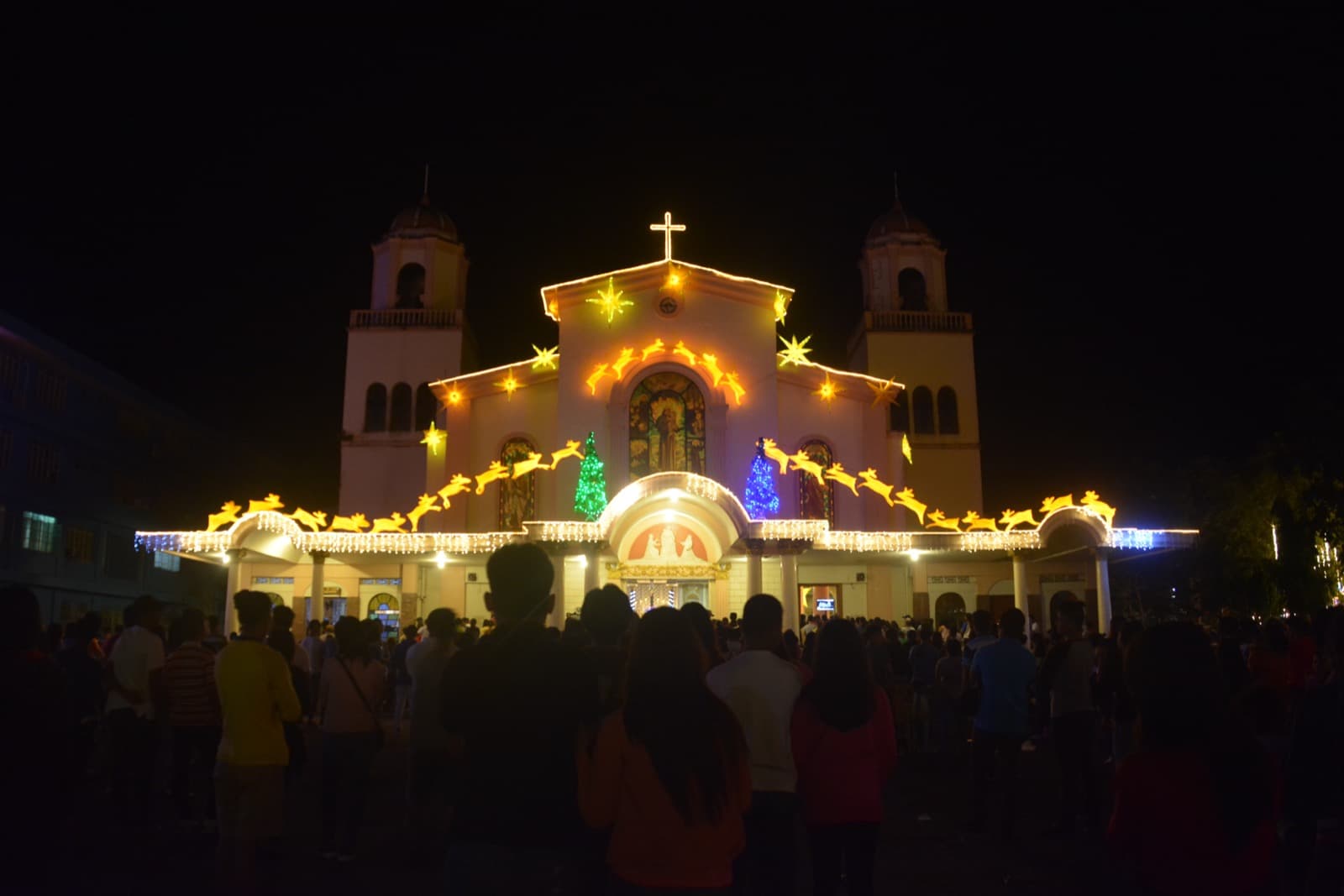
A church decorated with parols for Simbang Gabi. Wikimedia Commons (CC BY-SA 4.0)
By the Numbers: Simbang Gabi in the United States
We searched our database of over 19,000 active Catholic parishes for Simbang Gabi services:
Unexpected states with Simbang Gabi: Alaska, Indiana, Louisiana, Minnesota, Missouri, Connecticut, Michigan
Estimating the Full Picture
How many parishes actually celebrate Simbang Gabi in America? We can estimate using Filipino population data.
Los Angeles reports 100+ parishes serving ~550,000 Filipino residents (18 parishes per 100,000). Chicago's 55 parishes serve ~135,000 Filipinos (41 per 100,000). With 4.5 million Filipino-Americans nationwide:
Conservative estimate: 800+ parishes
Upper estimate: 1,800+ parishes
Our sample: 136 parishes (~10-15% of total)
The Geography of Filipino America
The Simbang Gabi map tells the story of Filipino immigration to America.
California dominates because that's where Filipinos first arrived in large numbers. In the 1920s and 30s, young Filipino men - the Manongs - came to work California's agricultural fields. Larry Itliong and Philip Vera Cruz helped launch the 1965 Delano grape strike alongside Cesar Chavez.
Hawaii's presence reflects an even older connection. By 1925, half of all plantation workers in Hawaii were Filipino. Today, Filipinos make up about 25% of Hawaii's population.
The healthcare corridor - Texas, Illinois, Tennessee, Florida - traces a different migration. After the 1965 Immigration Act, Filipino nurses flooded into American hospitals. Today, Filipinos are just 1% of the U.S. population but comprise 4% of the nursing workforce.
Filipino nurses, recruited to serve in one of the poorest regions of Appalachia, brought their families and their faith. In a county where 25% of children live below the poverty line, these healthcare workers have helped revitalize a parish that serves just 74 families.
The Catholic Extension Society calls communities like this proof that "Asian Catholic communities are growing everywhere and helping the Church thrive in America."
How America Changed Simbang Gabi
Evening instead of dawn. Of the 350 services in our database:
208 (59%) are held at 5pm or later
79 (23%) maintain the traditional pre-6am timing
The rest fall somewhere in between
Rotating parishes. In many cities, neighboring parishes each host one night of the novena. Filipino families travel from church to church, creating a pilgrimage across the city.
Growing beyond Filipinos.Phoenix had to move celebrations to larger venues due to growing attendance from non-Filipino Catholics drawn to the beautiful tradition.
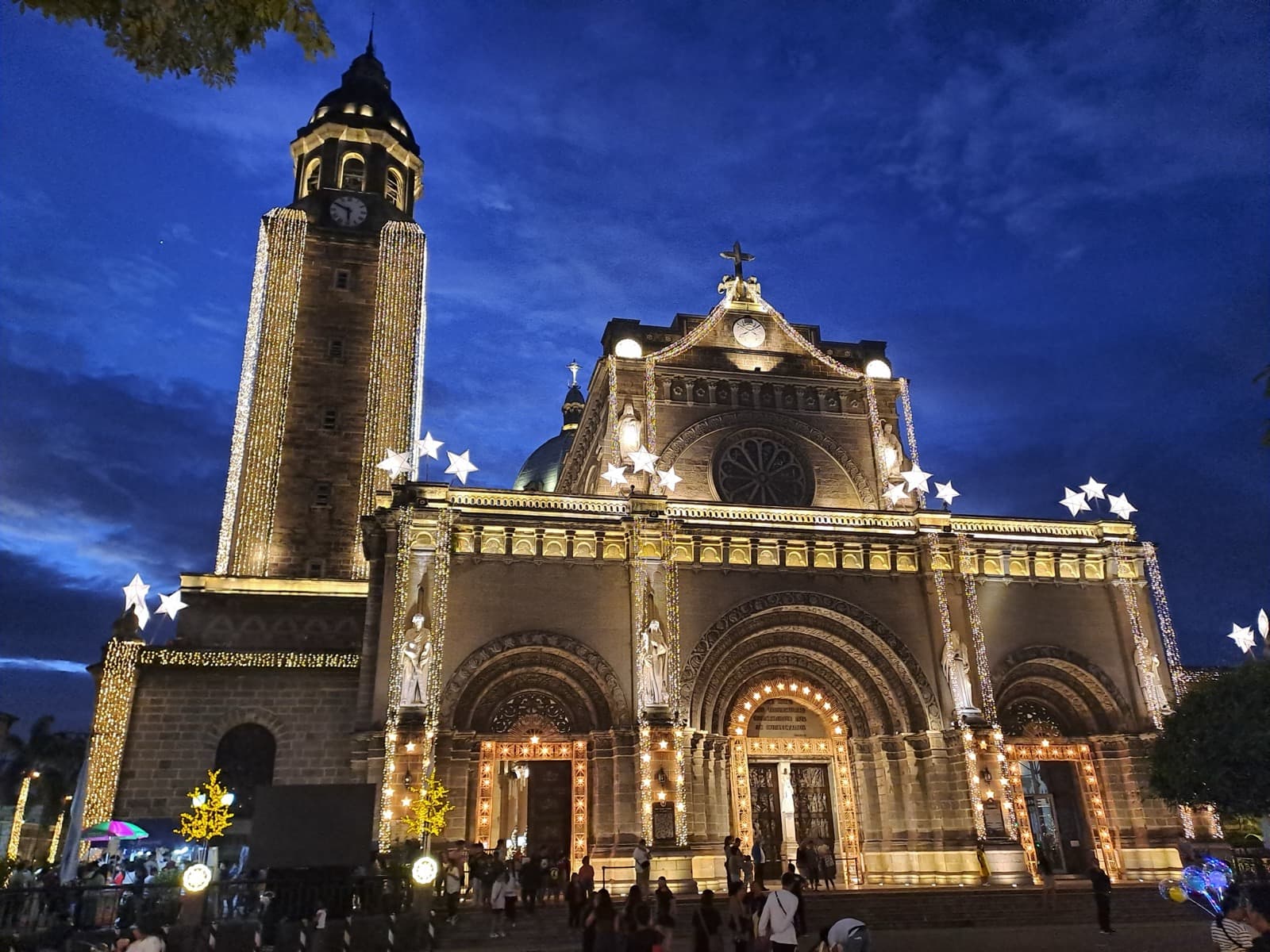
Manila Cathedral during Simbang Gabi. Wikimedia Commons (CC BY-SA 4.0)
A retired Filipina nurse who emigrated in 1976 explained why she still attends Simbang Gabi every year: "It's a Catholic tradition instilled in us by our parents, and now we try to instill that tradition in our children."
There are 4.5 million Filipino Americans in the United States. About 65% identify as Catholic. During COVID-19, Filipino nurses made up 4% of the nursing workforce but represented 31% of nurse deaths. They were on the frontlines - serving in the places others wouldn't go, often far from Filipino communities, far from Simbang Gabi, far from home.
But every December, even in Kodiak, even in Hazard, the parols come out. The novena begins. Nine days of Mass. Nine days of prayer. Nine days of a community holding onto something sacred.
Find Simbang Gabi Near You
Catholic Index tracks Mass times at over 19,000 parishes across the United States, including seasonal traditions like Simbang Gabi.
Data sourced from parish bulletins and websites, current as of December 2025. Services were identified through our parish schedule database. Our sample captures ~10-15% of estimated celebrations nationwide.
Know of a Simbang Gabi celebration we missed? Contact us →